
Stephen Jay Gould’s
Wonderful Life: The Burgess Shale and the Nature of History is both a
brilliant history of the Burgess Shale fossils and its discoverer Charles
Doolittle Walcott, and an in depth look at the zoology of the animals behind
the fossils. However, this book is not an easy read in many ways and is
certainly not for the faint of heart. Gould does not hold back on the zoology. He bandies about scientific terms and
evolutionary debates as though every potential reader has at least a Bachelor degree
in biology. Yet despite of my own background in invertebrate zoology and
taxonomy, there was a period of time where I put the book down and wondered,
“Why am I pushing myself to read this?”. Perserverence is key, as by the time
Gould wraps up the book all of the time spent learning about the work done in
the 1970s on these fossil animals makes perfect sense.
Gould proclaims the Burgess Shale the most important fossil
bed in the world as it was the first major find of fossils of soft-bodied
creatures from the period just after the pre-Cambrian explosion 570 million
years ago. The Cambrian explosion itself is important as it “marks the advent
(at least into direct evidence) of virtually all major groups of modern animals
– and all within the miniscule span, geologically speaking, of a few million
years”. For Gould, the story of the Burgess Shale is interesting on a human
scale from where classification of the fossils began with Walcott, the
discoverer, and where it ended up with the reexamination by Harry Whittington
of Cambridge University.
When Walcott discovered the Burgess Shale in southeast
British Columbia during a field season in 1909, he was the head of the
Smithsonian Institution in Washington, DC. Walcott’s commitments to
administrative tasks led to years of putting serious research into his Burgess
fossil collection on the backburner. He published a few preliminary papers, and
a few monographs on some of the sponges and algae but none on the more complex
animals. Unfortunately Walcott was not able to spend more time with his fossils
during his retirement as he died shortly after it began.
After his death, Walcott’s wife prevented any serious study
of the Burgess Shale fossils, primarily as she believed no one was up to the
task. The massive fossil collection languished on high and out-of-the-way
shelves in the Smithsonian. No paleontology student or research was likely to
come upon them and have a eureka moment that would launch them into a lifetime
of research, further pushing the Burgess Shale fossils to the back of every
paleontologist’s mind. It was not until 1959 that one of the first major
post-Walcott publications on Burgess Shale arthropods appeared. Leif Stormer, a
Norwegian paleontologist, created a classification scheme published in the
collectively written “Treatise on Invertebrate Paleontology”. Stormer’s
classification was entirely different from Walcott’s, bringing nearly all arthropods
into the same grouping as trilobites based on what he saw as similarities in
their primitive appendages.
It was with Stormer’s classification that Harry Whittington,
a paleontologist out of Cambridge University, and his two grad students, Derek
Briggs and Simon Conway Morris, began their own intensive study of the Burgess
Shale fossils. Much of this book is a discussion of the dilemmas thrown up
during fossil study. Whittington started with an analysis of Marrella splendens as it is by far the
most abundant fossil in the Burgess Shale. Walcott, in 1912, admitted that Marrella was not a conventional
trilobite, but still placed it in the class Trilobita even as some of his
contemporaries expressed their doubts. However, even these doubters did not
stray from the notion that all of the Burgess fossils should fit into
classification groups already known, even if they did not seem to fit. In 1971
Whittington knew that Marrella was
different, but even he felt constrained by the belief that Burgess fossils were
old yet primitive versions of modern species, and to keep Marrella in the Class Trilobita despite evidence that suggested
otherwise.
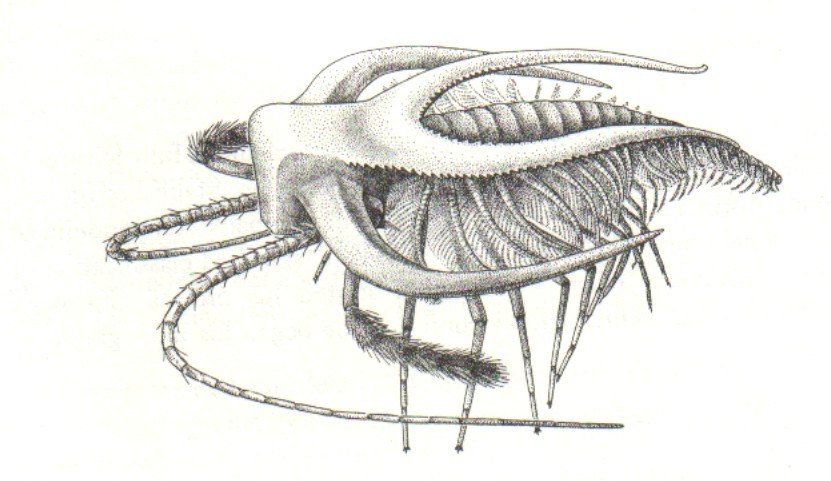
For example, when he was working on reconstructing Marrella’s head with its appendages, he
came up with a very different configuration than Walcott. In fact, Stormer had
also seen differences in his own reconstructions compared to Walcott, and had
decided to ignore the head when making his classification (instead
concentrating on leg structure). Upon studying the illustrations Walcott had
made of Marrella’s head, Whittington
noticed that they had been retouched to the extent that they were essentially
falsified, showing mouth part features that were not there. Despite these
differences, and those Whittington noticed in the legs, Gould writes that “on
the brink of a transforming insight he chose caution and tradition this one
time – and placed Marrella in Stormer’s
Trilobitoidea…yet as he did so felt the pain of betraying his own better
judgment.”
Regardless, this first study and its conservative conclusion
by Whittington eventually led to a revolution in classification of the Burgess
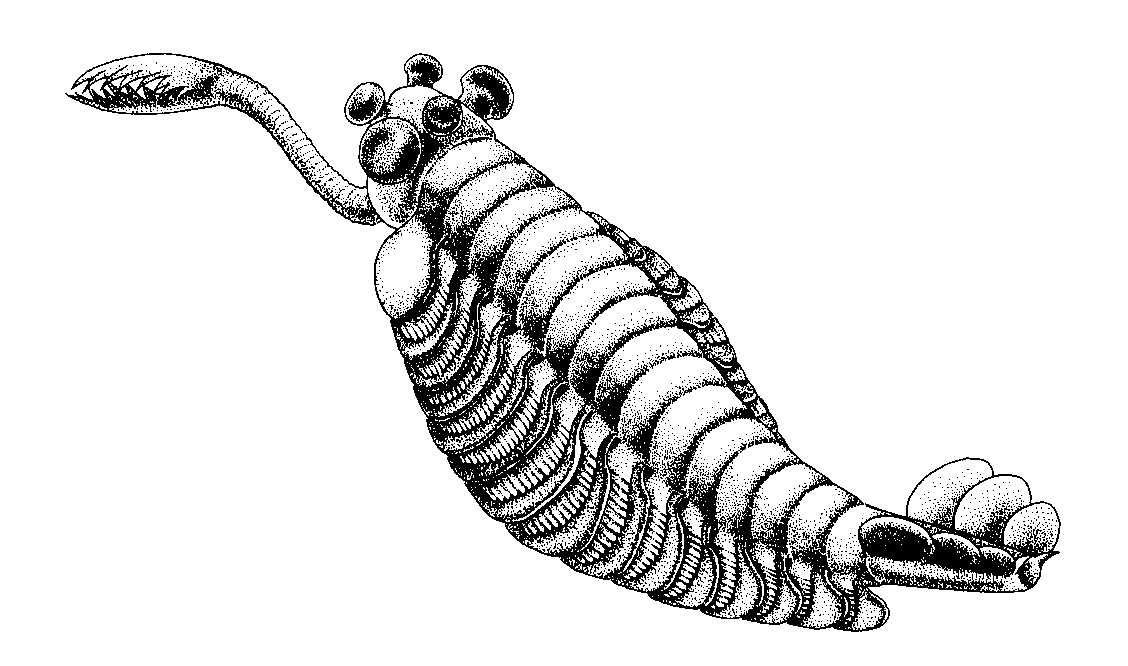
fossils. The third Burgess fossil Whittington worked on, Opabinia, was what Gould calls a “eureka moment” in this restudy. By
dissecting one of the ten fossil specimens of this organism, Whittington found
that Walcott had been mistaken in his classification: it did not have the right
leg appendages to be classed as an arthropod, nor did it have any features that
would classify it in any of the known groups. It was an orphan. Finally, Whittington
was able to free himself from the constraints of fitting a specimen into the
existing scheme, and could simply describe an organism as he saw it, writing in
his monograph, “My conclusions on morphology have led to a reconstruction which
differs in many important respects from all earlier ones.”
The more Burgess organisms Whittington’s team investigated,
the more they confirmed that Burgess organisms in the Cambrian showed body
plans beyond the range of those seen in later times. There was tremendous diversity
and disparity at the time, and as evolution proceeded this was whittled down to
fewer different body plans in fewer different groups of organisms. These
reclassifications of Burgess fossils are significant, as they demonstrate how
the beliefs and world view of society or the paleontologist of the time can
affect how the fossils are seen to
fit in to the evolutionary record. More generally, how the personal views of a
scientist can affect their interpretation of a revolutionary scientific idea. Gould
associates Walcott’s “shoehorn” of Burgess fossils into existing taxonomical
groups with his traditional, conservative, political, social and religious
beliefs.
The remainder of the book is an exploration of this as Gould
postulates evolutionary “what if” scenarios that challenge the notion that
there is only one way to think about the progression of life, based on preconceptions
of scientists like Walcott. Gould ends up reminding us that we should not let
ourselves be led into thinking that there is only one path to take, one choice,
one way of doing things because it is the one that we are willing to accept
based on our expectations or comfort level. We need to explore what is
possible, and be willing to accept even the most revolutionary idea, the most
revolutionary change.

